

Home
News - Events Science & Technology News Research results on the application of robots in a detergent powder manufacturing plant
Featured News


Research results on the application of robots in a detergent powder manufacturing plant
The research topic on applying robots in a detergent powder manufacturing plant was conducted by Dr. Phan Đăng Phong, M.Sc. Đinh Viết Hải, M.Sc. Trần Sỹ Kiên.
ABSTRACT:
For units in the chemical industry, due to the risk and hazardous factors from chemicals directly affecting humans and the environment, the application of Industry 4.0 technology and production automation is increasingly receiving attention. The research and development of automation systems in the production of detergent powder and cleaning agents are being focused on and invested in by many domestic companies and organizations. These systems are developed to reduce dependence on labor, increase productivity, and ensure safety in the process of loading and unloading goods. Recognizing this need, the National Research Institute of Mechanical Engineering has early invested in research, cooperation, and allocation of resources to gradually master the calculation, design, and integration of automation systems for units under the Vietnam Chemical Industry Group.
This paper presents the results of research, design, manufacturing, and integration of an automation system using robots (in two stages: packaging and palletizing) for LIX Detergent Powder Joint Stock Company, contributing to the completion of the production automation line of this unit.
Keywords: Automation, detergent powder plant, robot system, weighing and dosing system.
1. Overview of the detergent powder production line
The detergent powder production process can be summarized into three stages: Detergent powder processing, detergent powder packaging, palletizing and transportation.
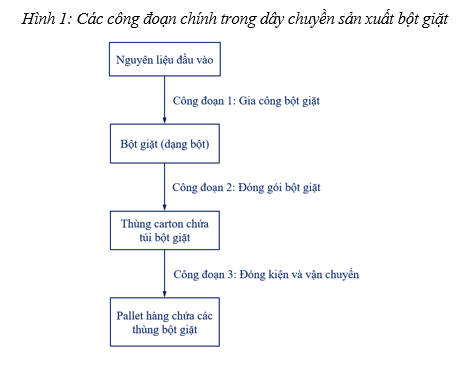
- Detergent powder processing stage:
Input raw materials are processed to create the final product of detergent powder, ready for packaging and delivery to users. Different processing methods for detergent powder will use different equipment, including:
+ Mixing equipment: Stirring and mixing solid and liquid input raw materials to create cream-like semi-finished products.
+ Drying/agglomeration equipment: The cream-like semi-finished products pass through drying/agglomeration equipment to become crude powder.
+ Pump equipment: Performs the work of pumping cream (pumping to the high tower in the spray drying method), pumping additional raw materials such as fragrances and additives.
+ Screening equipment: Filtering out powder products that do not meet quality (size) standards before packaging.
Currently, in detergent powder manufacturing enterprises, the powder processing stage is all carried out with automated equipment, with humans playing a role in setting parameters, operating, and monitoring the system.
- Detergent powder packaging stage:
The detergent powder is then transferred to the packaging stage into bags of various weights. Dosing the product for packaging is based on a weighing and dosing system. This stage requires high precision as it directly affects the efficiency and production costs of the enterprise. With traditional manual methods such as non-automatic scales or automatic scales with older technology, the error in detergent powder packaging weight is often large and output productivity is very low, leading to high labor costs and difficulty meeting expansion needs.
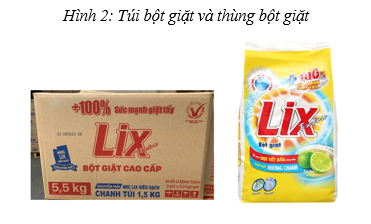
After the weighing and dosing system determines the amount of detergent powder to be packed into each bag, the packaging machine seals the bag and applies labels. The detergent powder bags are then packed into cartons according to a predetermined quantity per carton.
- Palletizing and transportation stage:
The cartons containing detergent powder bags are palletized for convenient transportation and storage. In detergent powder manufacturing enterprises, the number of product types and weight ranges is often very diverse, so the packaging cartons come in many different sizes along with different palletizing specifications. Currently, most of these units use manual labor for palletizing, which affects productivity and palletizing quality.
2. Automation solution for the production line
With the existing production lines in factories, to improve production automation, further research and improvement of several equipment and stages are needed. As analyzed in the limitations above, at the detergent powder packaging stage and the palletizing and transportation stage, most current systems do not meet enterprise requirements regarding accuracy, quality, productivity, and human resources. These systems have high scientific content and applicability in manufacturing plants in Vietnam. Therefore, the National Research Institute of Mechanical Engineering (NARIME) has conducted research, calculation, design, and manufacturing of automation solutions including a weighing and dosing system and an automatic robot palletizing system.
2.1. Detergent powder bag packaging stage
In the packaging stage, the weighing and dosing system will be responsible for controlling the weight of detergent powder packed into bags for each product type. The product weighing and dosing system includes mechanical structure, loadcells, pneumatic assembly, motors, and a control panel directly connected to existing equipment at the factory.
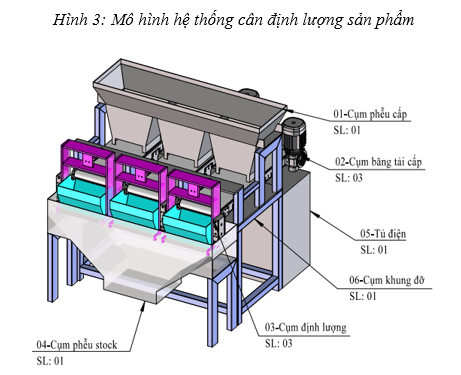
Because the system operates in a chemical environment with corrosive and destructive properties, to ensure long-term durability and stability, all proposed solutions use equipment and scales made of stainless steel (SUS 304, SUS 316). PVC conveyor belts are abrasion-resistant, chemical-resistant, and especially have flexibility to increase accuracy when weighing small quantities. The operating mechanism of the product weighing and dosing system in the packaging stage:
- Detergent powder is discharged into the supply hopper assembly and 3 conveyor belt sets. To ensure productivity and accuracy during weighing, the feeding conveyor belt will be programmed (controlled by inverter, servo motor) with multiple speed levels (fast feed, slow feed). The initial discharge into the dosing hopper will be fast feed – coarse weighing (high-speed conveyor belt), then the conveyor belt speed is reduced – fine weighing (low-speed conveyor belt). For each product type (bag weight), the corresponding conveyor belt speed will be set and programmed.
- The loadcell at each dosing hopper is set with an appropriate increment to ensure accurate weighing (fine weighing) process.
Basic measurement requirements for the product weighing and dosing system in the packaging stage are as follows:
- Accuracy: is the algebraic value calculated by the difference between the scale reading when weighing the weight of the detergent powder amount and the actual mass value of this detergent powder amount.
- Sensitivity: Sensitivity (at a given load) of the scale is the ability of the scale to react to small changes in load. Sensitivity is evaluated by the gentle change of the added weight causing a change in the stable equilibrium state on the scale indication (this movement can be observed on the indicating device).
- Repeatability: Repeatability (at a given load) is the maximum difference among several weighings of the same load under the same measurement conditions.
All measurement specifications for the scale type and accuracy class are specifically and strictly stipulated in the Vietnamese Metrology Technical Document ĐLVN 16:2021.
2.2. Palletizing and transportation stage
The palletizing and transportation process in the detergent powder production line will perform the following main tasks:
- Palletizing: Placing the cartons containing finished detergent powder bags onto a pallet according to a predetermined pattern (called stacking specification). This task is also called product stacking. After the pallet is fully loaded with detergent powder cartons, it is secured with shrink wrap layers around it, and labeled with information including the detergent powder product name, production date, weight, etc.
- Transportation: After the pallet of goods is fully palletized, it is transported to a designated location before shipment or storage.
To completely replace humans in the above tasks, automatic stacking systems integrated with robotic arms have been widely applied worldwide since the 1980s. The use of robots brings flexibility to automatic stacking systems with an increasingly diverse range of product types. A robotic arm can be programmed to handle packages of different sizes or arrange them on pallets in multiple ways without requiring prior design changes.
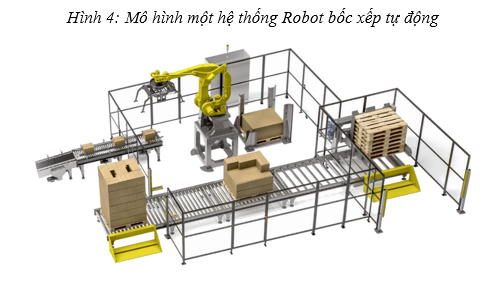
The robot palletizing system will automate the entire palletizing and transportation process, consisting of the following main components:
- Industrial robot arm: performs the task of stacking cartons according to a predetermined pattern; the programming for the robot will be carried out by the research team itself.
- Pallet dispenser: Brings empty pallets and places them into position for the robot to stack goods onto.
- Stretch wrapping machine: Wraps shrink film around the stacked goods after the robot has fully loaded them to ensure stability during transportation.
- Labeling machine: Outputs product type information, production date, etc. from the database and prints and applies labels to the palletized goods.
- Conveyor system: Transports cartons, empty pallets, and loaded pallets.
In addition, the robot palletizing system also includes other components such as: electrical-automation system (sensors, pneumatics, etc.), electrical cabinet, and safety fences.
3. Results of applying production line automation at LIX Detergent Powder Joint Stock Company
3.1. Automation system for the detergent powder bag dosing and packaging process
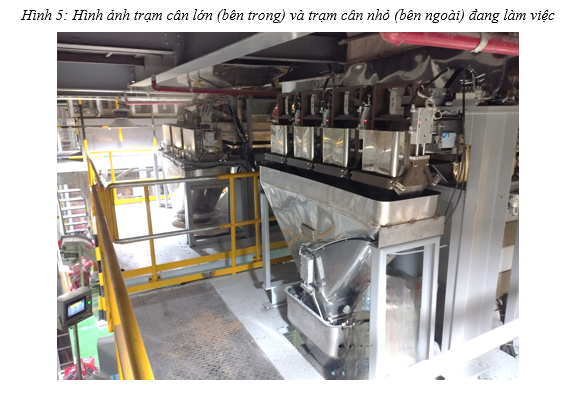
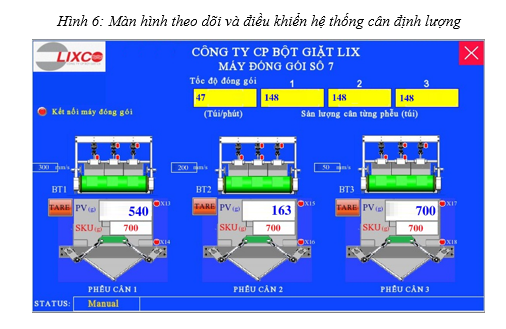
The weighing and dosing system consists of weighing stations designed and manufactured to work with different packaging weights of detergent powder bags: small weighing stations for sizes 100-1500 grams, large weighing stations for sizes 2-7 kilograms, ensuring a powder quantity error when packaging from 0.5% to 0.7%. At the same time, the packaging speed of detergent powder bags reaches up to 65 bags/minute (for 350g size bags), requiring the mechanical structure and electrical equipment to operate sequentially and continuously at high speed. This is considered a challenge for the Institute's engineering team during the calculation, design, and equipment selection process for the system.
Currently, the weighing and dosing system has been connected to other systems on the factory's detergent powder production line, operating continuously during working shifts with a productivity of 3 tons/hour for each small weighing station and 10 tons/hour for each large weighing station.
3.2. Automation system for the palletizing and transportation process
For LIX Detergent Powder Joint Stock Company, there were many difficulties compared to conventional automatic carton stacking systems, such as: limited working space, production line productivity, and carton stacking specifications. These difficulties directly affected the system design process.
The space around the system was optimally renovated to ensure stable robot operation as well as to save floor space. The arrangement of conveyor belts for bringing cartons was also cleverly organized to reduce the load on the robots. The gripper mechanism and robot program were also designed by the Institute's engineers to suit many different stacking specifications at the factory.
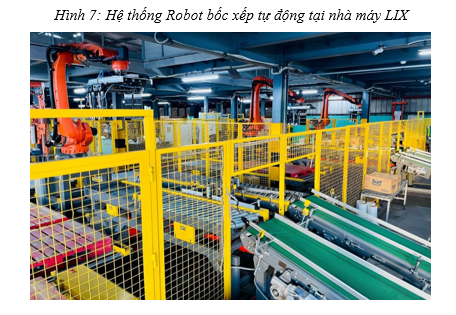
The automatic robot palletizing system at LIX Detergent Powder Joint Stock Company is currently operating to serve carton stacking onto pallets, palletizing, and transportation for 8 production machines of the factory, with a maximum of 6 different product stacking patterns simultaneously and a machine speed of up to 15 cartons/minute. Through monitoring, the average daily output of the automatic robot palletizing system can reach about 500 tons/day, operating continuously for 24 hours.
4. Conclusion
The engineers and scientists of the National Research Institute of Mechanical Engineering carried out the design, manufacturing, integration, and official commissioning of the automation system using robots (at the packaging and palletizing stages of LIX Detergent Powder Joint Stock Company) starting from December 2023. To date, the system has operated stably, met production requirements, and received high praise from the user unit.
The design, manufacturing, and commissioning of automation systems in production is an urgent requirement, on one hand to serve production needs and save foreign currency, and on the other hand to contribute to the development of the domestic industrial automation system manufacturing industry. The successful commissioning of the automation system using robots for the detergent powder production line at LIX Detergent Powder Joint Stock Company has contributed to affirming success in localizing industrial automation systems, serving as a basis for expanding application to other manufacturing sectors in Vietnam.
References:
[1] Documentation of the production line automation system at LIX Detergent Powder Joint Stock Company
Source: Industry and Trade Magazine
Related News
- Discuss solutions to promote foundational industries in the new period
- Specific mechanisms and policies are needed to develop mechanical engineering products with large market capacity in the period 2026-2045.
- Mastering Heat Exchange Equipment: A New Step Forward for Vietnam's Mechanical Engineering Industry
- Resolution 57-NQ/TW creates a strong impetus for science and technology in the Industry and Trade sector.


