

Featured News




Coreless Winding Head Device Made in Viet Nam
The coreless rotary head device is the first technological product researched, designed, and manufactured by scientists from the Key Laboratory of Welding and Surface Treatment Technology – National Research Institute of Mechanical Engineering. This research contributes to improving domestic technical and technological standards with the aim of effective application in production, promoting the Institute's leading role in the field of mechanical engineering and automation.
The technological device is a product of a project originating from practical requirements
Currently, heat exchange systems are widely used in the cement, thermal power, chemical, paper, textile, and other industries. During operation, the pipes of heat exchange systems become clogged with scale and require maintenance and cleaning. Domestic enterprises often apply various methods to clean the inner pipe surfaces, mainly using imported equipment and materials. However, besides high costs leading to increased production expenses, under certain specific conditions, limitations are revealed such as low cleaning efficiency, lack of safety, and complex operating procedures. The chemical cleaning method is only suitable for small systems; for large systems, the cost is very high, time-consuming, and unsafe due to the side effects of chemicals on equipment.
From that reality, the project “Design and manufacture of a coreless rotary head device for cleaning scale from pipe interiors using high-pressure water” was initiated. From the initial results, the author team conducted in-depth research, improvements to expand technical capabilities, and enhanced the practical application of the pressure-based pipe cleaning device, achieving unexpected results. The experimental run results of cleaning the interior of a heat exchange tower pipe at the Acid Plant – Lam Thao Superphosphate and Chemicals Joint Stock Company showed that the design calculations and manufacturing of the coreless rotary head device as set by the project were very promising for field testing. After testing, the results were: The pipe interior was cleaned without causing cracks or deformation; cleaning productivity reached 35 m/h. Under the specific field conditions, the cleaning productivity of the rotary head was 3 times higher than registered. Field cleaning productivity was 7 times higher than previous cleaning methods at Lam Thao Superphosphate and Chemicals Joint Stock Company.
Uniqueness of the device
The coreless rotary head device is a technological product researched, designed, and manufactured for the first time in Vietnam. The product has a new structure and design, not overlapping with any similar equipment product in the world. Its operating principle uses high-pressure water and air combined with rotational movements, centrifugal hammer blades with self-aligning radial capability, working ability independent of pipe length, cleaning all types of scale including clogging deposits. It can be used on-site even with non-dismantled structural installations, operable in all positions: vertical, inclined, or horizontal. The coreless rotary head has a simple, compact, lightweight, and unique structure, easy to use, flexible and smooth inside the pipe, ensuring safety in use, very suitable and effective for cleaning heat exchange systems... The improvement has resulted in a product capable of cleaning even clogged pipes thanks to the combined scale-drilling rotary head.
The device can be combined with chemicals according to a specific procedure to increase efficiency and address particular difficulties of pipe cleaning work. Notably, it has no secondary harmful effects on structures, reduces pollution and environmental toxicity, and can work in various chemical scale environments. The product meets the requirements for cleaning scale from heat exchange pipe interiors with diameters from Ø36 to Ø50. Productivity can reach up to 1 m2/min under specific conditions.
The test results of the project product were highly appreciated by the applying unit, and they proposed cooperation for periodic cleaning in the future, helping the unit to be proactive, improve production efficiency, and reduce labor costs and overall cleaning expenses. In particular, the manufacturing cost of the device is low due to its simple structure, fairly common materials, shared pressure source, and the pressure source's lifespan independent of the working environment.
Developing research results for widespread application
Experimental results have demonstrated the applicability of the device with outstanding advantages. The effectiveness of this method is based on basic characteristics such as: The bonding nature of scale differs from the crystal lattice structure of the pipe; the mechanical impact of the hammer head on the scale in the form of pulses with high impact frequency makes it very easy to remove scale from its position; the self-aligning ability and good surface adherence to the pipe interior provide favorable conditions for scale cleaning; secondary effects are negligible.
There is almost no chemical effect due to the use of air, water, and neutral media as working fluids. Mechanical effects are very low because the pulse energy is distributed across each hammer blade. Therefore, it can be used to clean scale inside graphite pipes or non-metallic pipes. Due to direct mechanical interaction with the scale surface, this method minimizes waste of materials and energy, which is the basis for increasing productivity, reducing costs, and improving efficiency.
This reality creates a development direction for research and manufacturing of suitable coreless rotary heads no longer limited to the product "Coreless rotary head combined with scale drilling for cleaning clogged pipes" (successfully applied at Lam Thao Superphosphate and Chemicals Joint Stock Company and DAP – VINACHEM Joint Stock Company). If a self-propelled rotary head assembly combined with a pipe cleaning monitoring device is researched, designed, and manufactured, it can be applied to clean pipes with large diameters and lengths. Thus, this new cleaning method can not only be applied to heat exchange systems but also to many other fields such as transportation, irrigation, civil works, and oil and gas.
Research, design, and manufacture of a coreless rotary head for cleaning pipes using high-pressure water is a completely new proposal in Vietnam. With the goal of developing technology for practical application, actively meeting domestic demand, and replacing imported products. The successful manufacture of the coreless rotary head device will be widely applied and is very necessary in thermal power plants, chemical plants, cement plants, building materials factories, and textile factories.
Box: The project "Design and manufacture of a coreless rotary head device for cleaning scale from heat exchange pipe interiors using high-pressure water and air" was chaired by the Key Laboratory of Welding and Surface Treatment Technology – National Research Institute of Mechanical Engineering. The project leader was MSc. Ngo Xuan Cuong, co-leaders Assoc. Prof. Dr. Le Thu Quy, MSc. Do Thanh Tung, and collaborator MSc. Nguyen Anh Dung. This is a Ministry of Industry and Trade-level project, accepted in January 2016, and subsequently continuously improved and perfected for application at Lam Thao Superphosphate and Chemicals Joint Stock Company from 2016 to 2019.
The project won the second prize of VIFOTEC 2018, a certificate of merit for scientific and technological creativity from the Vietnam General Confederation of Labor 2018, the Vietnam Golden Book of Creativity 2019, a certificate of merit from the Prime Minister 2019, and the rotating flag of the Ministry of Science and Technology – Vietnam Union of Science and Technology Associations.
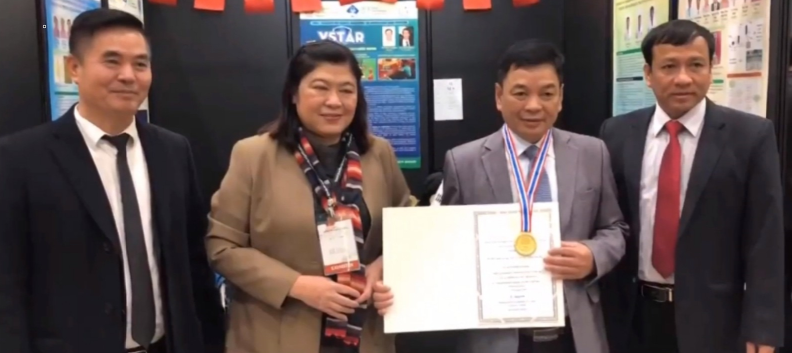
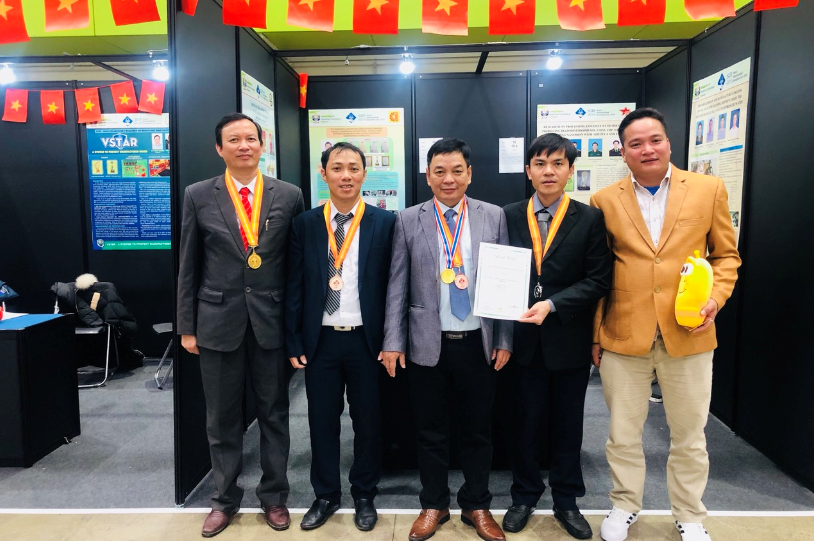
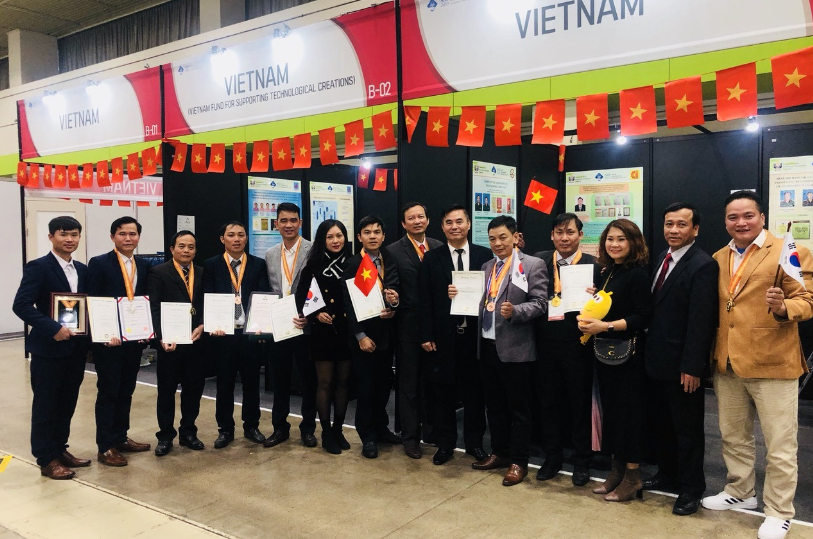
The project won an international third prize and a THAILAND gold prize at the International Invention Fair SIIF 2019 – Seoul, South Korea.
Some images of award presentations to the authors and the research team.
Related News
- Discuss solutions to promote foundational industries in the new period
- Research results on the application of robots in a detergent powder manufacturing plant
- Specific mechanisms and policies are needed to develop mechanical engineering products with large market capacity in the period 2026-2045.
- Mastering Heat Exchange Equipment: A New Step Forward for Vietnam's Mechanical Engineering Industry


