

Home
Products & Services Renewable energy Floating solar power plant equipment, a new research direction of the National Research Institute of Mechanical Engineering
Featured News



Floating solar power plant equipment, a new research direction of the National Research Institute of Mechanical Engineering
Nguyen Ha An, Nguyen Van Binh – Center for Hydro-Mechatronics
Solar power is a clean energy source, with electricity production costs less volatile to changes in input fuel prices compared to other traditional energy forms, and investment costs are always decreasing over time thanks to the development of photovoltaic (PV) panel manufacturing technology.
According to the Clean Energy Association, Vietnam is one of the countries with the most sunlight on the world solar radiation map. On average, total solar energy radiation in our country ranges from 4.3-5.7 million kWh/m2. In the Central Highlands and South Central provinces, sunshine hours are quite high, reaching 2,000-2,600 hours/year. Average solar radiation of 150 kcal/m2 accounts for about 2,000-5,000 hours/year. The adjusted Power Development Plan VII sets a target of producing about 850MW of solar power by 2020, increasing to 4,000MW by 2025 and 12,000MW by 2030.
In Vietnam, several solar power projects have been implemented. The Hoi An – Con Dao plant built from March 2014 (capacity 36kWp, electricity output about 50MWh, total investment about 140 thousand Euros) was completed and connected to the grid of Con Dao Power in early December 2014. Most recently, on May 12, at Vam Cong Industrial Cluster, Lap Vo district, Dong Thap province, Sao Mai Group energized the Sao Mai 1 solar power plant with a capacity of 1.06MW, total investment about 2 million USD. This is currently the largest solar power plant in Vietnam [1].
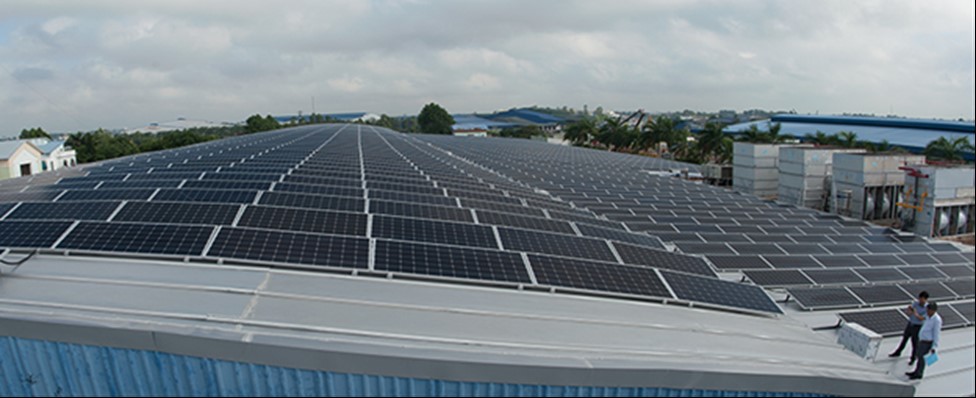
Photo: Solar panels at Sao Mai 1 plant [1]
The Government has decided to purchase solar power at a price of 2,086 VND/kWh (9.35 cents/kWh), much higher than the purchase price from other power sources. This affirms the Government's determination to develop solar energy and encourages businesses to invest in solar power. To date, the country has had about 30 domestic and foreign investors promoting and establishing solar power projects with capacities from 20MW to over 300MW, mainly concentrated in the Central region. Among these investors, Da Nhim – Ham Thuan – Da Mi Hydropower Joint Stock Company is the first unit to register investment in floating solar power on the surface of Da Mi hydropower reservoir with a capacity of 47.5MW, expected to occupy 50 hectares of the reservoir surface.
Solar power requires area to accommodate photovoltaic (PV) panels exposed to sunlight. Panels placed on the ground often occupy large land areas and are considered difficult for solar power development due to land clearance costs and local land funds. To overcome these difficulties, the world has researched utilizing hydropower and irrigation reservoirs to locate plants. Currently, there are up to 70 floating solar power plants with generating capacities from 5 to 20000 KW [2]. Another advantage is that placing panels on water yields higher efficiency than on land due to evaporative cooling. The difficulty when placing panels on water is the durability of floating materials and water level fluctuations in reservoirs, so research is needed on floating materials, floating raft connection schemes, and raft anchoring schemes in the reservoir.
The National Research Institute of Mechanical Engineering is currently coordinating with other units to research equipment systems for floating solar power plants:
– Research on floating pontoon systems and anchoring systems: Materials for manufacturing floating pontoons, standards, methods for testing mechanical, physical, and chemical durability, and durability over time; Production, connection, and on-site assembly plans for pontoons; Machinery and equipment for manufacturing and installing pontoons; Calculation and design of anchoring systems, applicable standards, etc.
– Research on PV panels, connection systems, power transmission, inverters, measurement and control systems, etc.
Based on the research results achieved, in the coming time, the Institute will cooperate with reputable units worldwide to master the technology of designing, manufacturing, and installing floating equipment systems for solar power plants in Vietnam, meeting the requirements of investors for building floating solar power plants.
References
[2] http://www.solarassetmanagement.us/download-floating-plants-overview/
[3] http://english.kwater.or.kr/eng/main.do
[4] www.ciel-et-terre.net


