

Home
News - Events The National Research Institute of Mechanical Engineering must pioneer research, development, and innovation.
Featured News
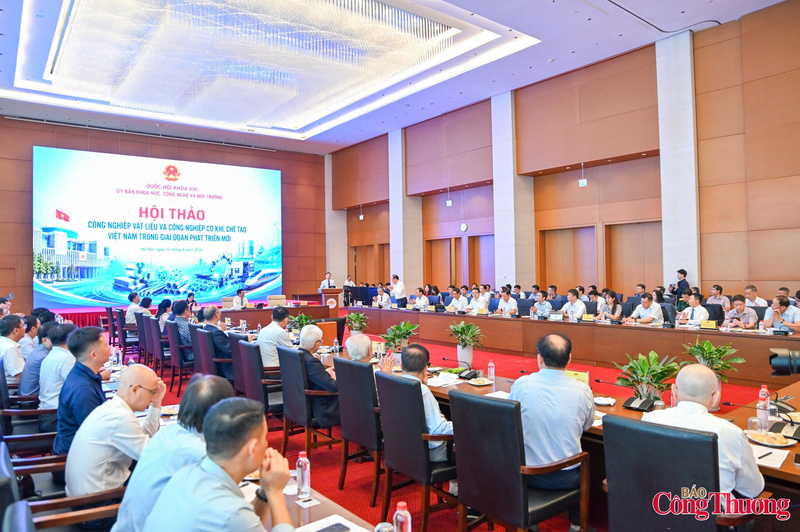

The National Research Institute of Mechanical Engineering must pioneer research, development, and innovation.
Minister Nguyen Hong Dien requested the National Research Institute of Mechanical Engineering to enhance its leading role, focusing on foundational industries and high technology.
Affirming the leading role and promoting the internal strengths of Vietnam's mechanical engineering sector
On the afternoon of July 4th, Minister of Industry and Trade Nguyen Hong Dien had a working session with the National Research Institute of Mechanical Engineering. Attending the meeting were representatives from various departments, agencies, and units under the Ministry of Industry and Trade.
After a period of urgent and serious work, the conference essentially completed its set agenda. Following the concise and clear report by Comrade Phan Dang Phong, Director of the National Research Institute of Mechanical Engineering, nearly 20 opinions were expressed by leaders of functional units and research institutes under the Ministry.
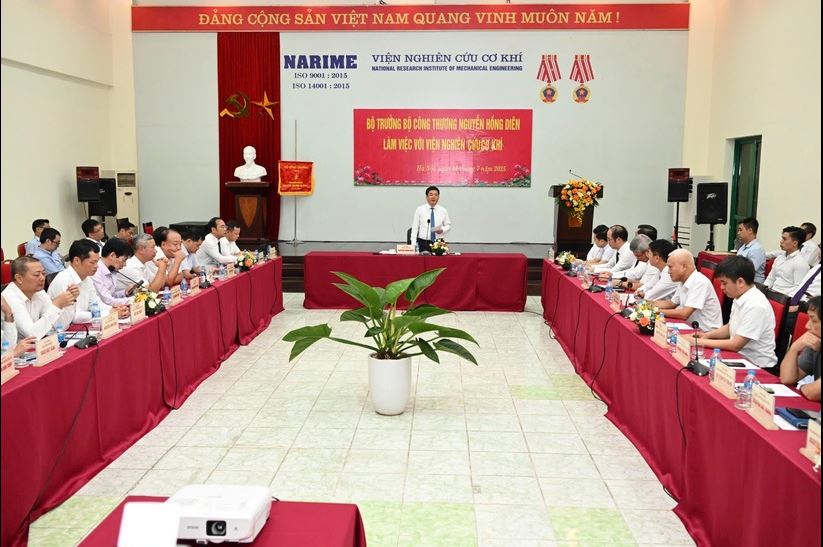
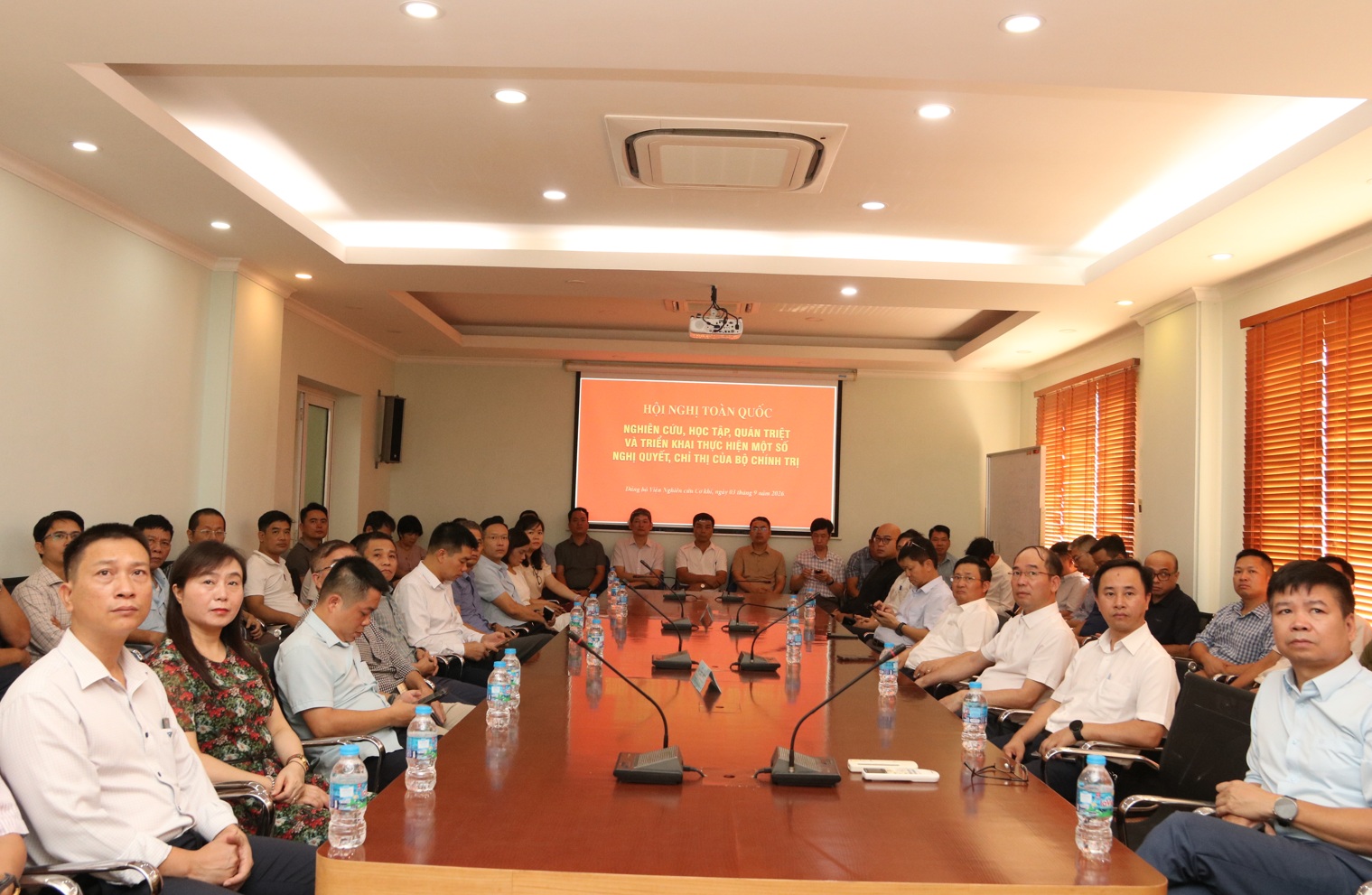
Overview of the working session. Photo: Can Dung
According to Minister Nguyen Hong Dien, overall, the opinions were basically unanimous in recognizing that in recent years, the National Research Institute of Mechanical Engineering has been united, dynamic, proactive, creative, and striving to rise, achieving many outstanding results.
Firstly, the National Research Institute of Mechanical Engineering has gradually affirmed its role as the leading research unit, laying the foundation and creating a breakthrough for the development of the mechanical engineering - automation sector of the country - a foundational, "backbone" industry that enhances the independence and self-reliance of the national economy.
Secondly, the Institute has performed its policy advisory role quite well, actively contributing to the development of strategies, plans, standards, regulations, and technical-economic norms in the mechanical engineering and manufacturing sectors. Notably, recently the Institute has completed and submitted to the Ministry for approval a Project on developing electromechanical equipment, increasing the localization rate, creating favorable conditions for the domestic mechanical engineering sector to participate in the supply chain of equipment for domestic production industries, reducing dependence on foreign countries, and contributing to the realization of the country's Industrialization and Modernization goals.
Thirdly, the Institute has not only performed well in research and development and mastering foundational technologies, but has also proactively and actively applied the results of scientific and technological research effectively into practical life, mastering the design and manufacturing in several key, foundational industrial fields (such as: hydraulic mechanical equipment, complete equipment systems in thermal power, mineral extraction and processing, automobiles - motorcycles, new energy, high technology, production process automation, etc.).
Fourthly, postgraduate training and doctoral research in the mechanical engineering - automation specialization at the Institute have been carried out quite well, contributing to the continued development of high-quality human resources and actively contributing to the development of the Sector and the country.
Fifthly, The work of building and developing the Party and consolidating and improving the operational effectiveness of mass organizations at the Institute has been given attention; the superior Party Committee has rated it a typical clean and strong Party Committee for 5 consecutive years.
However, alongside these positive results, the Minister noted that the Institute still has some shortcomings, such as the dissemination of guidelines and policies not being synchronized, task implementation effectiveness sometimes low; proactiveness and quality of policy advice still limited; uneven staff qualifications, especially in foreign languages and practical skills. The causes of these limitations include both objective and subjective factors, with the main subjective causes being:
Some leaders of the Institute and leaders of its units have not yet thoroughly, fully, and promptly understood the guidelines, policies, and mechanisms related to the Sector's fields of activity in general, especially newly emerging fields (such as semiconductor industry, high-speed railways, nuclear power, and a series of tasks the Sector is being assigned by the Party and State...), leading to hesitation and lack of proactive participation in major national and Sector programs and projects; they have not been proactive in advising and proposing to the Ministry effective policy orientations and organizational implementation of tasks assigned by the Party and State.
Additionally, the learning spirit to improve qualifications among some cadres and employees of the Institute is not yet very high; a portion of cadres and employees are weak in foreign languages, have limited ability to absorb and master technology and solve scientific and technological problems arising in practice; some research topics have high production costs, making them difficult to apply in practice.
"The Institute needs a strategy and plan for training, retraining, and advanced training for its staff both domestically and internationally, but must have a reasonable management and utilization mechanism," Minister Nguyen Hong Dien stated.
Coordination in work among units within the Institute and with Ministry units or fields sharing the same functions has not been very good, with limited effectiveness, especially in advising on the formulation of mechanisms and policies for Sector development.
5 key tasks and long-term development orientations for the National Research Institute of Mechanical Engineering
Minister Nguyen Hong Dien emphasized: Our country is entering a new period of development in the context where science and technology, innovation, digital transformation, and international integration are dominant trends and developing strongly, bringing many opportunities and advantages, but also full of difficulties and challenges.
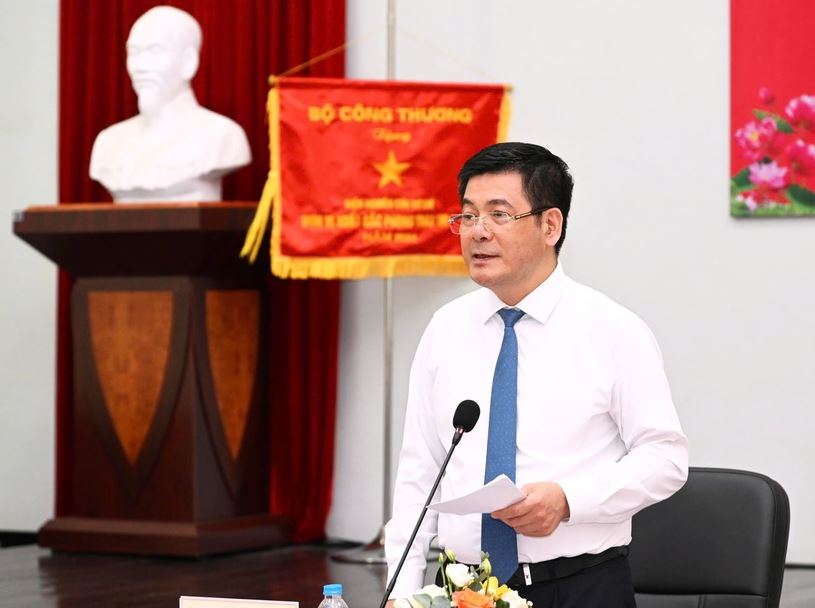
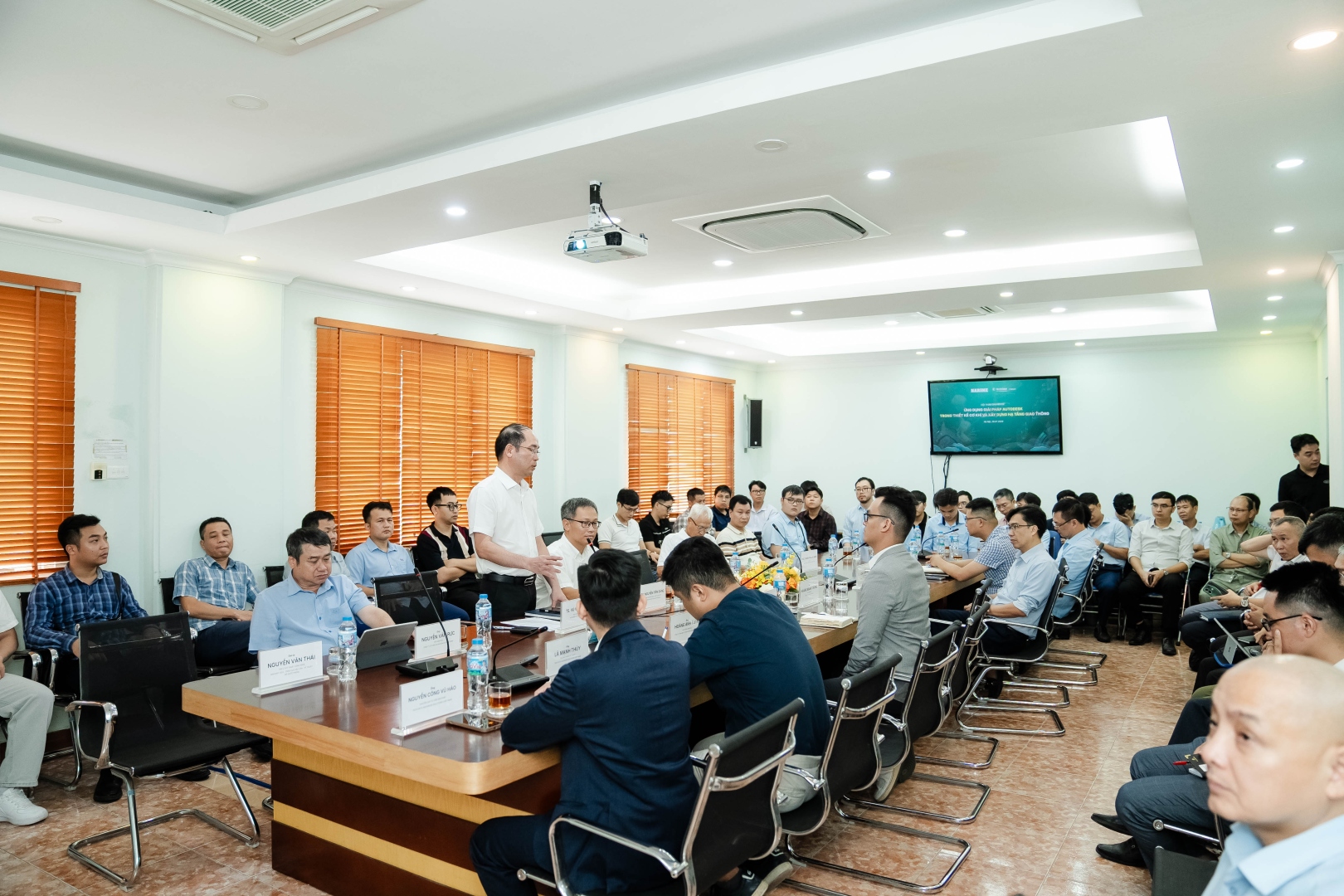
Minister Nguyen Hong Dien delivers a directive speech. Photo: Can Dung
The mechanical engineering and manufacturing sector plays a particularly important role in sustainable economic development, because it not only provides input materials for many other industries, mitigating adverse impacts from external fluctuations, but also creates sustainable added value, enhances the competitiveness and self-reliance of key industrial products, and promotes the country's Industrialization and Modernization process.
Recently, the Party and State have issued many important guidelines and policies to promote the development of technology in general, and the mechanical engineering and manufacturing sector in particular (especially the Politburo has issued 4 important, breakthrough Resolutions on: developing science, technology, innovation, and national digital transformation; promoting international integration; reforming the building and enforcement of laws; developing the private economy in the new situation.
The National Assembly has also issued a Resolution on piloting some special mechanisms and policies to create breakthroughs in developing science, technology, innovation, and digital transformation; approved the investment policy for a series of major national projects and works such as the Ninh Thuan nuclear power plant, the North-South high-speed railway; the policy to implement the Lao Cai - Hanoi - Hai Phong railway line construction investment project; piloting specific and special mechanisms and policies to develop the urban railway network in Hanoi and Ho Chi Minh City; national sector plans, especially in the fields of petroleum, gas, energy, electricity, etc.
"These are also new opportunities that the National Research Institute of Mechanical Engineering, as well as other Institutes and units under the Ministry, need to study, and then set their own tasks, objectives, and find their own solutions to strive for implementation. These are very favorable factors, creating important motivation for domestic mechanical engineering enterprises and functional units to develop," Minister Nguyen Hong Dien stated.
According to the Minister, in this context, the Science and Technology research activities of the National Research Institute of Mechanical Engineering, as well as other research institutes under the Ministry, must be linked to the development of foundational, key industries and emerging industries, high-tech industries, contributing to promoting smart manufacturing and digital transformation in line with the trend of the 4.0 Industrial Revolution.
To enable the National Research Institute of Mechanical Engineering to continue sustainable development and contribute more actively to the development of the Sector and the country, the Minister requested that the leadership, staff, and workers of the Institute focus on effectively implementing the following key tasks:
Firstly, continue to study, thoroughly understand, and implement effectively the Party's guidelines and viewpoints, and the State's regulations and policies related to the Industry and Trade sector in general and the mechanical engineering - automation field in particular; especially: (1) Resolution No. 6 of the 13th Central Committee on continuing to promote Industrialization and Modernization of the country by 2030, with a vision to 2045; (2) Resolutions No. 57, 59, 66, 68 of the Politburo and Resolution No. 193 dated February 19, 2025, of the National Assembly on piloting special mechanisms and policies to create breakthroughs in developing science, technology, innovation, and national digital transformation; (3) The Project on restructuring the Industry and Trade sector for the period up to 2030, approved by the Prime Minister...
At the same time, continue to consolidate and improve the quality of operations of institutional bodies (such as the Party Committee, Leadership Board, and mass organizations); enhance the responsibility of party committees and heads; maintain unity and consensus, and promote the pioneering and exemplary spirit of cadres and party members in the execution of tasks, contributing to the entire Sector's successful fulfillment of the political tasks assigned by the Party and State.
Secondly, focus on restructuring the organizational apparatus towards being streamlined, professional, with a modern governance system to continue innovating and improving the quality and effectiveness of the Institute's operations; in which, focus on core values, promote specific strengths to build and develop the Institute into a leading research and deployment center in Vietnam in the field of mechanical engineering - automation, with prestige in the regional and international markets.
Thirdly, continue to perform well the function of advising on policies, providing scientific and practical evidence to help build and complete the policy system and development strategies for the Sector and the country.
Additionally, take the lead in research, development, application, technology transfer, and innovation, especially for core technologies in fields where the Institute has strengths; be proactive and bold in participating in high-tech, emerging industrial sectors with high growth potential that can change the operational mode of other industries (such as semiconductor industry, renewable energy, nuclear power, self-driving cars, artificial intelligence (AI), robotics, railway industry, production of new materials, biotechnology...), contributing to increasing the localization rate of domestically produced machinery and equipment, promoting the development of Vietnam's mechanical engineering - automation sector in a modern direction.
"Vietnam's economic integration in recent times has achieved many successes, but the goal of integration cannot be measured solely by the number of Free Trade Agreements (FTAs) signed, the number of Foreign Direct Investment (FDI) projects attracted, or the high annual export turnover. It must also be measured by the ability of Vietnamese enterprises and functional units to participate in the global production and supply chain. As the pioneering units of the Sector and also the pioneering units of the country in specific fields, I hope you will pay attention to performing your functions better," the Minister noted.
Fourthly, focus on strongly innovating operational methods towards enhancing linkages with large Corporations and General Companies, taking enterprises as the center; all scientific and technological research activities must be linked to production, originating primarily from practical requirements to produce practical, effective scientific and technological products with strong influence within the Sector and nationwide, which are quickly and effectively applied in practice, helping enterprises in the Sector gradually innovate technology, improve productivity, product quality, and competitiveness.
Pay attention to training, fostering, and building a team of experts and scientific researchers with high professional qualifications and capacity, and strengthen investment, exploitation, and effective use of modern facilities and research equipment, contributing to enhancing the potential of science and technology, moving towards mastering new technologies, especially those of the 4.0 Industrial Revolution.
"The Ministry of Industry and Trade has and is maintaining broad and close relationships with partners, especially development partners, along with cooperation programs in training, research, application, and development. This creates conditions for the National Research Institute of Mechanical Engineering and other Institutes under the Ministry to participate," the Minister stated.
At the same time, gradually form intellectual property assets (including inventions and utility solutions) to promote the commercialization of products through joint ventures, capital contributions, and production expansion using the Institute's intellectual property assets.
Fifthly, strengthen cooperation with prestigious universities and research and training organizations domestically and internationally, within and outside the Sector, to exchange, share, collaborate on research, and acquire advanced professional expertise and management skills from the region and the world, in line with the trend of integration and the development of Industry 4.0.
At the same time, continue to expand and further improve the quality and effectiveness of postgraduate training and doctoral research in mechanical engineering - automation and other foundational, key industrial specializations, contributing to training and developing high-quality human resources, actively contributing to the sustainable development of the Institute, the Sector, and the country.
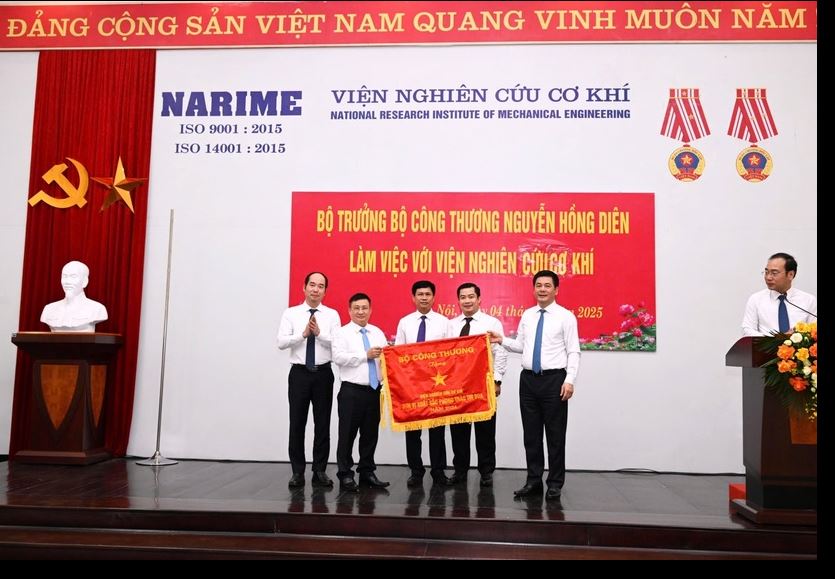
On this occasion, Minister Nguyen Hong Dien awarded the Emulation Flag of the Ministry of Industry and Trade to the National Research Institute of Mechanical Engineering for its outstanding and exemplary achievements in emulation movements, contributing to the cause of building and developing the Vietnamese Industry and Trade sector in 2024. Photo: Can Dung
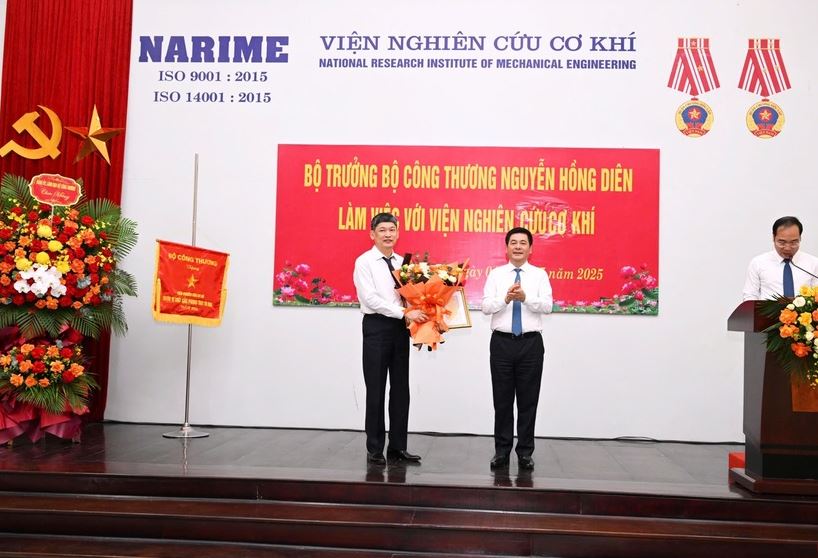
At the same time, presented the Certificate of Merit from the Minister of Industry and Trade to Mr. Nguyen Van Minh - Director of the Heavy Mechanical Center, National Research Institute of Mechanical Engineering, for outstanding achievements in work during the 2023-2024 period. Photo: Can Dung
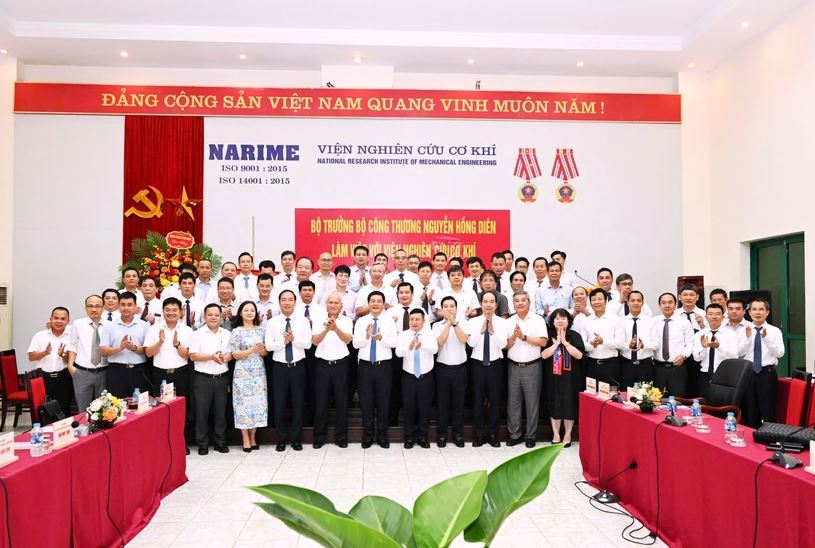
Minister of Industry and Trade Nguyen Hong Dien and delegates take a commemorative photo. Photo: Can Dung
At the working session on July 4th, the National Research Institute of Mechanical Engineering made 6 recommendations and proposals under the purview of various units (Agency for Innovation, Green Transition and Industrial Promotion; Agency for Industry, Department of Planning, Finance and Enterprise Management); Representatives of the leaders of the Ministry's functional units exchanged and responded to some of the Institute's recommendations. The Minister also gave directive opinions to address the Institute's recommendations and proposals.
Source: Cong Thuong Newspaper
Related news:
https://congthuong.vn/bo-truong-bo-cong-thuong-lam-viec-voi-vien-nghien-cuu-co-khi-409183.html
Related News
- Discuss solutions to promote foundational industries in the new period
- Research results on the application of robots in a detergent powder manufacturing plant
- Specific mechanisms and policies are needed to develop mechanical engineering products with large market capacity in the period 2026-2045.
- Mastering Heat Exchange Equipment: A New Step Forward for Vietnam's Mechanical Engineering Industry


