

Home
News - Events Building mechanisms and creating incentives for the localization of equipment in the urban railway sector
Featured News

Building mechanisms and creating incentives for the localization of equipment in the urban railway sector
Localization of equipment for the urban railway sector not only creates more jobs for the domestic mechanical engineering industry but also helps the railway sector reduce investment costs.
Regarding this issue, a reporter from the Industry and Trade Newspaper had an exchange with Dr. Phan Đăng Phong, Director of National Research Institute of Mechanical Engineering (Ministry of Industry and Trade).
Sir, the localization of equipment in the urban railway sector not only creates more jobs for the domestic mechanical engineering industry but also helps the railway sector reduce investment costs, ensures proactiveness in repair and maintenance during operation. What is your assessment on this matter?
According to the transport plan of Hanoi capital to 2030 with a vision to 2050 approved by the Prime Minister, Hanoi will build 10 urban railway lines with a total length of 417.8 km. To date, only 13 km (Cat Linh - Ha Dong line) have been completed and 12.5 km (Nhon - Hanoi Station line) are under construction, meaning that in the future the remaining 404.8 km must be completed with an estimated implementation cost of about USD 37 billion.
 |
| Dr. Phan Đăng Phong, Director of the National Research Institute of Mechanical Engineering |
The urban transport plan of Ho Chi Minh City to 2020 and vision after 2020 according to Decision 586/QD-TTg shows that the city will have 8 underground and elevated railway lines with a total length of 169 km, of which only 95% of Line 1 (Ben Thanh - Suoi Tien) with a total length of 20 km has been completed, and Line 2 (Ben Thanh - Tham Luong, 11 km) has commenced construction. Thus, in the future, an additional 138 km must be completed with an estimated implementation cost of about USD 12.6 billion.
Thus, according to some experts, if there are appropriate priority mechanisms and policies for the development of the urban railway industry, the domestic localization rate could reach over 79% - 83%, equivalent to USD 39.18 billion - USD 41.16 billion.
This is a very large market, currently left open to foreign equipment suppliers, while domestic mechanical enterprises cannot participate or participate only to a very limited extent, and the manufacturing mechanical engineering sector for railway equipment is virtually non-existent and cannot develop.
With many years of experience in research, development and technology transfer in the field of mechanical engineering - automation, what is your assessment of the current situation of equipment supply for the railway sector?
Most investment packages in the urban railway transport sector are being implemented by foreign contractors in the form of EPC (Cat Linh - Ha Dong line, EPC general contractor China; Ben Thanh - Suoi Tien line, EPC general contractor Japan - Vietnam joint venture; and Nhon - Hanoi Station line, EPC general contractor South Korea). Foreign contractors subcontract some domestic items at low costs, such as construction, installation, and lighting packages.
Domestically, there are a number of industrial facilities under the Vietnam Railways Corporation that specialize in manufacturing, repairing, and replacing equipment in the railway sector. However, most of these industrial facilities operate at a minimal level, with products mainly dependent on production orders from the Vietnam Railways Corporation, and their ability to diversify products to participate in the mechanical engineering market of the economy remains modest.
Meanwhile, the cost of replacement parts for locomotives and carriages is high, with about 80% of demand still imported annually. Industrial facilities can only meet a small proportion due to outdated machinery and limited technological capabilities.
Some other domestic enterprises have undertaken work of similar difficulty as general contractors for coal-fired thermal power, gas thermal power, and hydropower projects, such as LILAMA, PVC, NARIME, etc. However, no domestic unit has yet served as a general contractor for projects related to the railway sector.
Therefore, to date, domestic mechanical enterprises have not participated in the design and manufacture of equipment items, but have only performed simple tasks such as supplying replacement parts or acting as subcontractors for construction and installation from foreign EPC contractors.
To promote the localization of equipment in the urban railway sector, what mechanisms and policies do you think are needed? Can you suggest some specific solutions for the localization of equipment in the urban railway sector?
In recent years, closely following Vietnam's priority development policies, domestic mechanical enterprises have successfully cooperated and developed with a number of reputable foreign partners in several major national projects, such as projects in hydropower, thermal power, mineral exploitation and processing, new energy, and renewable energy.
There are three models that have been successful in designing and receiving technology transfer in the field of complete equipment lines to date. Model 1: Purchasing the design and gradually acquiring and mastering the technology through each project. This model was successfully implemented with Zaproghidrostal Company (Ukraine) for hydro-mechanical equipment projects for hydropower plants.
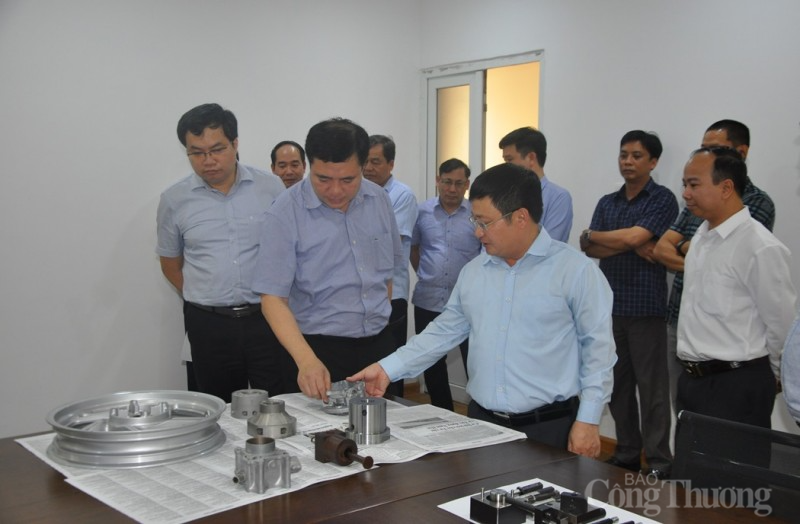 |
| Dr. Phan Đăng Phong, Director of the National Research Institute of Mechanical Engineering, introduces research achievements in the field of mechanical engineering - automation to the working delegation of the Ministry of Industry and Trade |
Before 2003, all hydro-mechanical equipment for hydropower plants was purchased at high costs, and there was no proactiveness in maintenance, repair, and replacement. With the Government's preferential mechanism in Document 797/CP-CN, the Ministry of Industry and Trade allowed NARIME to purchase technical design and technology from abroad for the first project, the A Vuong hydropower project.
The manufacturing part would be carried out domestically under the supervision and guidance of domestic and foreign experts working together. From the second project onward, design and manufacturing would be done domestically, with foreign expertise only for design appraisal and purchase of certain details and components not yet producible domestically.
As a result, domestic mechanical enterprises have become self-reliant in designing and manufacturing hydro-mechanical equipment for more than 29 medium and large hydropower plants in the country, including the Son La (2,400 MW) and Lai Chau (1,200 MW) hydropower plants, creating more jobs for the domestic mechanical engineering industry and contributing to a reduction in product cost of at least 30% compared to before, bringing high economic efficiency to the projects.
The advantage of this model is that technology is immediately available and long-term cooperation with foreign partners is possible to implement various projects in Vietnam. The disadvantage is that it is not always possible to find a suitable partner willing to cooperate.
Model 2: Purchase of main technological equipment along with the requirement to provide design and technology for learning through projects. We implemented this model with FAM (Germany) for the Song Hau 1 Thermal Power Project, and with MHI (Japan) for the Thai Binh 1, Nghi Son 2, and Vung Ang 2 Thermal Power Projects.
Regarding cooperation methods, we cooperate with foreign partners to purchase main equipment for the first project, with the condition of providing detailed design for the entire project to learn gradually, while the foreign party remains fully responsible. From the second project, Vietnam will take the lead together with the foreign partner to design and supply equipment, only purchasing some difficult equipment not yet producible domestically.
The achieved results are that the Institute has successfully cooperated with foreign partners to implement coal supply, ash and slag disposal, and electrostatic precipitator systems for the Nghi Son 2, Thai Binh 1, and Vung Ang 2 Thermal Power Projects with a localization rate of over 60%. Through three projects to date, we can be self-reliant in system design, relying on foreign partners only for appraisal, inspection, and purchase of some details not yet producible domestically.
The advantage of this model is that it ensures project safety as the main equipment and 100% of the design are from foreign parties for the first projects. The disadvantage is that it will be more expensive and take more time to complete the mastery of technology.
Model 3: Directly hiring foreign experts to come to Vietnam to jointly implement the project. We implemented this model with HATCH Company (Australia) for the Tan Rai and Nhan Co Bauxite projects. Cooperation method: find and directly hire experienced experts to come to Vietnam to work with Vietnamese engineers on the project.
The achieved results are that the Institute cooperated with HATCH (Australia) to implement EPCM for the Tan Rai and Nhan Co Bauxite projects. To date, we can confidently implement EPCM for similar new projects. The advantage of this model is that the cost is very cheap compared to hiring a foreign company to implement. The disadvantage is that finding foreign experts with sufficient experience and technology ownership to cooperate is not always possible.
With the above three models, for reference in the urban railway sector, choosing Model 2 for implementation is appropriate, because it still ensures a foreign contractor with sufficient capacity and experience to guarantee the quality of the entire system while still achieving the desired localization rate.
To achieve this, it is necessary to develop mechanisms and policies to concretize this issue, such as: Investing in strengthening existing facilities to be capable of manufacturing and repairing railway equipment; selecting a number of suitable contractors to implement EPC in Vietnam with conditions for equipment localization according to a roadmap; standardizing management standards and train operation management software to ensure consistency across lines; developing other preferential mechanisms to encourage equipment localization...
To promote the spirit of self-reliance and self-strengthening of domestic mechanical enterprises, turning potentials, advantages, and even challenges into opportunities and driving forces for national development, and also to help us control project investment costs effectively, create more jobs for domestic mechanical units, reduce trade deficit, and create development momentum and breakthroughs for the economy right from the investment construction stage, the development of a policy mechanism for equipment in the urban railway sector is very necessary and urgent.
Source: Industry and Trade Newspaper
Related News
- Discuss solutions to promote foundational industries in the new period
- Research results on the application of robots in a detergent powder manufacturing plant
- Specific mechanisms and policies are needed to develop mechanical engineering products with large market capacity in the period 2026-2045.
- Mastering Heat Exchange Equipment: A New Step Forward for Vietnam's Mechanical Engineering Industry


