

Home
Products & Services Surface treatment welding Surface treatment using thermal spray coating technology
Featured News







Surface treatment using thermal spray coating technology
Assoc. Prof. Dr. Le Thu Quy – Key Laboratory for Welding and Surface Treatment Technology
In the field of surface treatment, thermal spray technology plays an important role, developing in parallel with other traditional technologies such as welding, plating, hot-dip coating, rolling, etc. Thermal spray technology originated with the first patents published in Switzerland in the early years of the 20th century. Figure 1 below highlights the key milestones in the history of the formation and development of thermal spray technology, including spray methods, spray materials, and spray equipment [1]. In the last few decades, thermal spray technology has made significant progress, notably with new technological methods such as High Velocity Oxygen Fuel (HVOF) spraying, Cold Spray, Warm Spray, Low Pressure Plasma Spray (LPPS), Solution and Suspension Spray, etc.
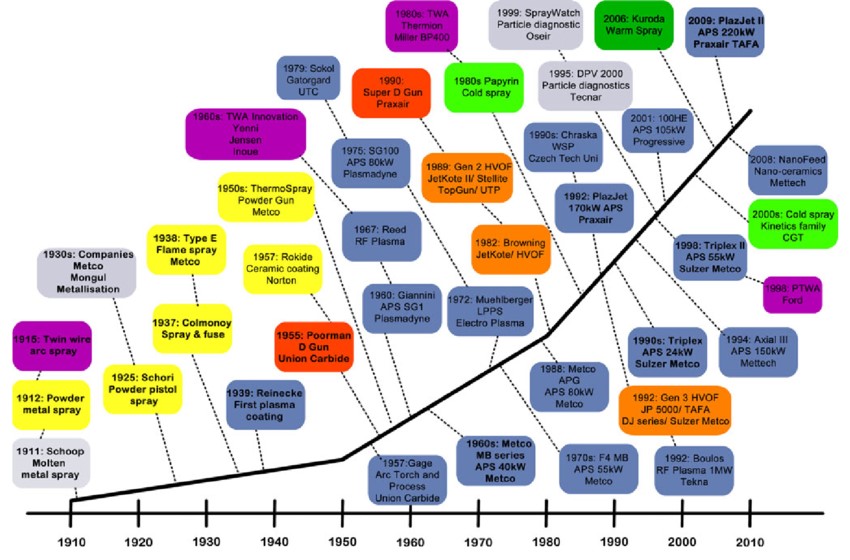
Figure 1. Key milestones in the history of thermal spray technology development [1].
Like other technologies, thermal spray must continuously evolve to meet new challenges and requirements. Thermal spray is now considered an environmentally friendly technology for designing and modifying surface properties and characteristics of machine parts. It is used in many fields, including transportation, energy, biomedicine, electronics, and mining [2]. The market value (revenue from material production, equipment supply, and coating manufacturing) was estimated in 2015 at approximately USD 7.58 billion, with an average growth rate of 7.79% per year, projected to reach about USD 11.89 billion by 2021 [3]. The main drivers for the development of thermal spray are the increasing demand from the energy, aviation, automotive manufacturing, and other economic sectors.
Thermal spray is continuously evolving to meet challenges arising from market needs and pressures such as price competition, regulatory requirements for products and input materials, and occupational safety and environmental regulations. However, these challenges are often accompanied by emerging opportunities. For example, the ban on the use of toxic hexavalent chromium products, which can cause cancer, creates opportunities for developing hard coatings to replace chromium, manufactured using less polluting thermal spray technologies.
Industry responds to these challenges in various ways, including traditional approaches (e.g., reducing costs, improving quality and reliability, increasing productivity and profitability through more efficient production approaches) and higher-risk approaches (e.g., developing new spray technology methods, innovating better spray nozzles, introducing spray materials with superior properties) [4].
In Vietnam, the research group on thermal spray led by Assoc. Prof. Dr. Le Thu Quy and colleagues at the Key Laboratory for Welding and Surface Treatment Technology – National Research Institute of Mechanical Engineering, in collaboration with the Institute of Tropical Engineering – Vietnam Academy of Science and Technology, has been established and developed for over 15 years. The thermal spray technology methods studied and applied include: flame spraying using wire, flame spraying using powder, electric arc spraying, plasma spraying, and HVOF spraying.
Over 15 years of development from 2002 to the present, with a research team consisting of 1 associate professor, 4 doctors, 8 masters, 5 engineers, and 8 technicians, the Key Laboratory for Welding and Surface Treatment Technology has achieved: annually 4-6 PhD candidates and master's students; chaired and participated in implementing 27 scientific and technological projects at various levels; published over 80 articles and scientific reports in domestic and international journals and conferences; trained 6 PhD candidates (3 have defended), 15 master's students, and over 60 university students completing graduation theses.
To date, thermal spray technology for surface treatment has been applied for hundreds of domestic manufacturing units. Six types of coatings have been and are being studied, including: Protective coatings against corrosion in water and atmospheric environments based on cathodic protection principles: Zn, Al, ZnAl; Protective coatings against corrosion based on anodic barrier principles: NiCr, Pb, Sn, Cu, stainless steel; Metal-organic composite coating systems; Carbide and ceramic coatings: ZrO2-Y2O3, Al2O3-TiO2, Cr3C2-NiCr, WC-Co-Cr; Nanocomposite coatings: containing nano Al2O3 components, carbon nanotubes CNT; Sealants for thermal spray coatings: aluminum phosphate, PTFE.
Future applied research directions of the Key Laboratory for Welding and Surface Treatment Technology – National Research Institute of Mechanical Engineering: Functional coatings including thermal resistance, corrosion and wear resistance, cavitation resistance, etc.; Nanostructured coatings; Sealants for thermal spray coatings: aluminum phosphate, PTFE; Post-spray heat treatment for coatings; New thermal spray methods: cold spray, solution and suspension spray, low pressure plasma spray, physical vapor deposition (PVD) coatings, chemical vapor deposition (CVD) coatings, etc.
References:
1.A. S. M. Ang, N. Sanpo, M. L. Sesso, S. Y. Kim, C. C. Berndt. Thermal spray maps: material genomics of processing technologies. Journal of Thermal Spray Technology 22(7) (2013) 1170-1183
2. ASM Handbook, Volume 5A: Thermal Spray Technology, R. C. Tucker, Ed., (2013).
3. Global thermal spray market – Segmented by product type, by end-user industry, and geography – Trends and Forecasts (2015-2020), Mordor Intelligence, May 2016.
4. A. Vardelle et al. The 2016 thermal spray roadmap. Journal of Thermal Spray Technology 25(8) (2016) 1376-1440.


