

Home
News - Events Science & Technology News For the first time, Vietnam has manufactured a system of raw material storage equipment for a cement plant.
Featured News



For the first time, Vietnam has manufactured a system of raw material storage equipment for a cement plant.
For the first time, leveraging domestic scientific and technological capabilities, a comprehensive raw material storage technology equipment system with a capacity of no less than 4,000 tons of clinker/day for cement plants has been researched and designed in Vietnam.
Increasing the localization rate of equipment for cement plants
The Ministry of Science and Technology has just approved a decision assigning the National Research Institute of Mechanical Engineering, Ministry of Industry and Trade to implement the national-level science and technology task "Research on design, manufacturing, installation and commissioning of synchronous equipment systems for comprehensive raw material storage for cement plants with a capacity of no less than 4,000 tons of clinker/day".
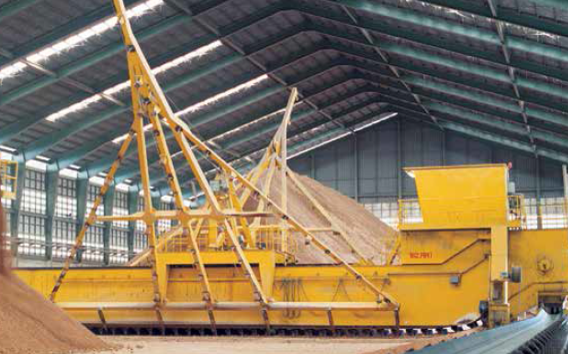
Material reclaiming machine – one of the equipment in the raw material storage system for cement plants to be manufactured by the National Research Institute of Mechanical Engineering
With a total implementation cost of 84 billion VND, the implementation of the project will contribute to increasing the localization rate of equipment for cement plants, enhancing the capacity of domestic mechanical engineering units, and promoting economic development. With product quality equivalent to imported goods, but at a reduced cost, the project also contributes to reducing the annual trade deficit. Especially, it significantly reduces costs for hiring foreign experts (approximately 70%) in project management, installation, operation, and maintenance of line equipment as previously done.
Engineer Vu Van Diep, project lead, stated that according to statistics, Vietnam has about 89 cement plants and grinding stations built nationwide. As the third largest cement producer in the world, after China and India, with abundant raw material resources, it is expected that from now until 2030, Vietnam will have at least more than 10 raw material storage facilities to be invested in and upgraded domestically, mainly synchronous equipment systems for longitudinal storage at VICEM cement plants and some domestic cement manufacturing plants such as Hoang Thach, Hai Phong, Bim Son, Tam Diep,...
However, during the construction of cement plants, all synchronous equipment systems for raw material storage at the plants are mostly supplied by foreign contractors. Besides, for plants in operation, after a period of operation, technological issues requiring upgrades and repairs are inevitable.
If no domestic unit grasps the technology and has the capacity to design and manufacture synchronous equipment, these upgrades would also have to be outsourced to foreign companies. Plants would have to bear a large cost to hire assessment experts from foreign companies and wait for replacement goods to be imported at very high prices, unable to proactively manage production plans, causing economic losses.
"Therefore, this supply cannot depend on foreign companies; there need to be domestic units that understand the technology and are capable of mastering the design, supply, manufacturing, installation, and operation of synchronous equipment systems for raw material storage" – Engineer Vu Van Diep said, also sharing that developing complete equipment in the building materials production sector is one of the key tasks in the Development Strategy of the National Research Institute of Mechanical Engineering until 2030 with a vision to 2040, which is being reviewed and approved by the Ministry of Industry and Trade.
Domestic capability sufficient for designing and manufacturing equipment
According to Engineer Vu Van Diep, with supportive and encouraging policies from the State, as well as the efforts of domestic mechanical engineering units, the Vietnamese mechanical engineering industry has so far made significant progress in localizing equipment for industrial plants in general and cement plants in particular. Design, machining, and manufacturing capabilities have been gradually enhanced.
The workforce of scientific researchers, managers, and skilled workers is increasingly strong. Localized mechanical products are increasingly diverse with high quality, meeting domestic and international standards. Many products have been ordered by foreign partners for domestic projects as well as for export.
Among them, the National Research Institute of Mechanical Engineering (NARIME) is a unit with many years of experience in technology consulting, design, and manufacturing of equipment for raw material transport systems for industrial plants, typically such as the material transport system for the Nhan Co Bauxite plant and the Tan Rai Bauxite plant, the ash and slag transport systems and dust filtration systems for the Thai Binh 1 and Nghi Son 2 plants, the coal supply system for the Song Hau 1 Thermal Power Plant...
In addition, other units such as the Institute of Machinery and Industrial Instruments (IMI), the Institute of Mining and Metallurgy Science and Technology... are units with extensive experience in consulting, technology design, design and manufacturing of spare parts and equipment for rotary kiln cement production lines such as bag filters, electrostatic precipitators, cement packing lines...
Along with that, some enterprises have participated in manufacturing steel structures and installing similar equipment for cement plants and thermal power plants such as LILAMA, COMA, MIE, VINAINCON... In 2005, LILAMA led the project "Research on design and manufacturing of key equipment for synchronous rotary kiln cement production lines with a capacity of 2,500 tons of clinker/day, replacing imports, implementing the localization process".
However, Engineer Vu Van Diep acknowledged that although domestic consulting, design, and mechanical manufacturing enterprises have grown strongly, gradually asserting the role of the mechanical engineering industry in the national economy, it must be recognized that the localization rate of equipment for raw material transport systems in cement plants is still at a low level, not yet meeting the goal of mastering the cement production line in terms of production technology design and equipment manufacturing.
This has clearly revealed inadequacies in the connection between consulting units to implement technology design, design and manufacturing of complete lines, with manufacturing, installation, and operation units operating separately and competing with each other.
If Vietnam can localize the synchronous equipment system for comprehensive raw material storage at 70-80% by weight (based on advanced design and technology), it will not only promote the development of science and technology in the field of cement plants, advancing the domestic mechanical manufacturing industry, but also create jobs for dozens of mechanical engineering enterprises with tens of thousands of workers for each project, while saving significant costs compared to the option of importing equipment.
"To achieve that, it is imperative that domestic consulting, design, manufacturing, and installation units connect and cooperate to implement the project from start to finish" – Engineer Vu Van Diep said, also informing that currently, Bim Son Cement Joint Stock Company has committed to cooperating with the Institute in implementing the project and using the project's products. This is an important basis for project implementation. In addition, the Institute will cooperate with companies such as LILAMA, COMA,... to manufacture, install, and operate equipment to ensure the project is implemented effectively and meets the set schedule and quality.
Related News
- Discuss solutions to promote foundational industries in the new period
- Research results on the application of robots in a detergent powder manufacturing plant
- Specific mechanisms and policies are needed to develop mechanical engineering products with large market capacity in the period 2026-2045.
- Mastering Heat Exchange Equipment: A New Step Forward for Vietnam's Mechanical Engineering Industry


