

Home
News - Events Science & Technology News For the first time, Vietnam has mastered the technology of steam sterilization of medical waste.
Featured News

For the first time, Vietnam has mastered the technology of steam sterilization of medical waste.
For the first time in Vietnam, a team of experts from the National Research Institute of Mechanical Engineering (Ministry of Industry and Trade) has successfully carried out “Research, design, manufacture and commissioning of a medical waste treatment system using moist heat sterilization method, with a capacity of 4,000 – 4,500 kg of waste/day”. This not only brings economic, social and environmental benefits but also represents a major step affirming the capabilities of domestic science and technology.
Effective replacement of traditional technology
Following engineer Nguyen Van Binh – Project Leader of the topic “Research, design, manufacture and commissioning of a medical waste treatment system using moist heat sterilization method, with a capacity of 4,000 – 4,500 kg of waste/day”, to learn about the actual situation at Environmental Equipment and Materials 13 Joint Stock Company (Urenco 13) – the unit applying the research team’s technology, we were extremely surprised by the volume of products and technological achievements manufactured by Vietnamese scientists.
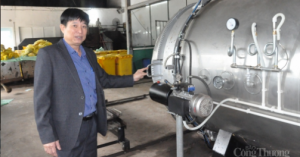
Engineer Nguyen Van Binh – Project Leader of the research, design, manufacture and commissioning
of the system for medical waste treatment using moist heat sterilization method
Sharing about the research purpose, engineer Nguyen Van Binh said: Infectious medical waste poses a risk to community health and the environment if its hazardous characteristics such as infectivity and disease transmission are not removed to turn it into ordinary waste and treat it as domestic waste. Currently, the world and Vietnam are using two main technologies for treating infectious medical waste: incineration technology and non-incineration technology. However, in developed countries, non-incineration technology has completely replaced incineration technology.
Meanwhile, in Vietnam, most medical facilities use incinerators to treat hazardous medical waste. Incineration technology aims to completely eliminate infectious agents in medical waste, turning them into CO2 and water vapor by burning waste at a temperature of about 1,000 degrees Celsius. However, the process of destroying medical waste by incineration technology reveals many disadvantages, namely generating secondary waste such as dioxins and furans – these are toxins that seriously affect human health and cause environmental pollution.
“The application of non-incineration technologies or medical waste treatment technology using moist heat sterilization not only eliminates the secondary waste dioxins and furans generated by the old technology but also constitutes an effective waste treatment step before landfilling without harming the environment, in line with the current global trend,” emphasized engineer Nguyen Van Binh.
At the same time, with this technology, Vietnam can fulfill the environmental protection conventions signed with the international community, such as: the 1985 Vienna Convention for the Protection of the Ozone Layer, the 1992 United Nations Conference on Environment and Development, the 1992 United Nations Framework Convention on Climate Change (UNFCCC), the 2001 Stockholm Convention on Persistent Organic Pollutants (POPs), etc., creating a clean environment for society.
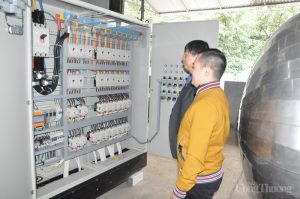
The medical waste sterilization technology manufactured by Vietnam features many superior improvements
Mr. Tong Viet Dung – Deputy Director of Urenco 13 – shared: Currently, the company is treating about 5 tons of medical waste per day. Previously, the company used traditional incineration technology. However, we soon realized that this technology had shortcomings, generating hazardous emissions. At the same time, the State has always recommended that enterprises invest in developing more environmentally friendly technologies.
Accordingly, since 2016, the unit has taken over a medical waste sterilization technology line sponsored by an international organization, with technology originating from the United States. This waste sterilization technology operates on the principle of using high-temperature saturated steam to eliminate all harmful germs, bacteria, and pathogens.
However, during the use of foreign technology, maintenance, repair, and replacement costs for equipment in case of problems caused considerable difficulties for the enterprise. Fortunately, two years ago, Urenco 13 met engineer Nguyen Van Binh and collaborated with the National Research Institute of Mechanical Engineering to implement a ministerial-level science and technology research project under the Ministry of Industry and Trade: “Research, design, manufacture and commissioning of a medical waste treatment system using moist heat sterilization method, with a capacity of 4,000 – 4,500 kg of waste/day”.
“We have made developments that enhance the superiority of the old system as well as fully Vietnamize the old US system so that we can master the technology and make it more suitable for Vietnam’s environmental conditions,” emphasized Mr. Tong Viet Dung.
Technology on par with the world
After many years of research, engineer Nguyen Van Binh and his colleagues have now manufactured: 1 autoclave according to design; 1 boiler according to design; 1 autoclave control cabinet; 1 boiler control cabinet (hardware and control software) and a set of technological procedures for moist heat sterilization medical waste treatment. The product has been authorized by the Ministry of Natural Resources and Environment for trial operation under Official Letter No. 6524/BTNMT-TCM dated November 18, 2020.
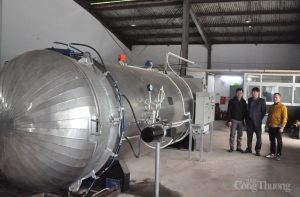
The medical waste treatment system using moist heat sterilization method currently undergoing trial operation at Urenco 13
After two months of installation and testing at Urenco 13 (Tay Mo Ward, Nam Tu Liem District, Hanoi), the results showed that the new system operates stably. Notably, microbiological tests of medical waste after being treated with the new system achieved results meeting the requirements of the National Institute of Hygiene and Epidemiology.
“The system manufactured by Vietnam shows greater superiority. The quality of treated waste remains the same, but the processing time is reduced to about 80% – 85%, and the capacity increases by about 15% – 20% compared to the technology of the world’s leading manufacturer of medical waste sterilization equipment. In particular, the foreign system is worth about four times as much as the system manufactured by the domestic unit,” said engineer Nguyen Van Binh.
Mr. Tong Viet Dung affirmed: The product of the project has a quality level equivalent to the imported product of GK-MOSS, USA. Therefore, the company as well as the National Research Institute of Mechanical Engineering very much hope that after the initial successful trial operation, the technology can be further replicated nationwide.
“The successful project will initially be replicated at member units of URENCO, treating medical waste centrally for hospitals in Hanoi and some northern provinces, and then can be expanded to hospital waste treatment units in the southern and central provinces of our country,” said Mr. Tong Viet Dung.
| At the recent basic-level acceptance council for the project held at the National Research Institute of Mechanical Engineering, experts highly appreciated the project’s results in terms of scientific significance, practical value, especially its novelty and technological creativity. Accordingly, they proposed that the Ministry of Industry and Trade and relevant authorities provide guidance and create conditions for the project’s lead organization to have a basis for transferring research results. |
Source: Cong Thuong Newspaper Link https://congthuong.vn/lan-dau-tien-viet-nam-lam-chu-cong-nghe-hap-khu-trung-rac-thai-y-te-150848.html
Related News
- Discuss solutions to promote foundational industries in the new period
- Research results on the application of robots in a detergent powder manufacturing plant
- Specific mechanisms and policies are needed to develop mechanical engineering products with large market capacity in the period 2026-2045.
- Mastering Heat Exchange Equipment: A New Step Forward for Vietnam's Mechanical Engineering Industry


