

Home
News - Events Localization of synchronous transverse Bias cutting line for the automotive tire manufacturing industry
Featured News




Localization of synchronous transverse Bias cutting line for the automotive tire manufacturing industry
16/04/2024
Cao Cuong, Vu Van Khoa, Do Van Ha
National Research Institute of Mechanical Engineering, Ministry of Industry and Trade
Although Vietnam has over 200 factories producing automobile and motorcycle tires, all production lines must be imported, leading to high product costs. To contribute to self-reliance in tire production technology, the National Research Institute of Mechanical Engineering has researched and localized the horizontal Bias cutting line, helping to reduce operating labor and energy costs, thereby increasing the competitiveness of Vietnamese automobile tires.
Domestic tire manufacturing industry
According to the Master Plan for Development of Vietnam's Automobile Industry to 2020, with a vision to 2030, the automobile industry is oriented to become an important industrial sector of our country. Vietnam's automobile industry sets a target that by 2020 it will meet 30-40% of the demand value for components and spare parts for domestic automobile production; in the period 2026-2030, this figure will be 50%.
Since 2010, Vietnam's tire manufacturing industry has seen continuous growth in export surplus value, with an increasingly large gap. To date, Vietnam has exported tires to the markets of 128 countries/territories. Currently, there are over 200 domestic enterprises participating in tire export. If tire production lines can be localized domestically, production costs will be reduced, enhancing product competitiveness.
Currently, three main types of tires are used worldwide: Bias (with cross-ply cords), Radial (with radial ply cords), and Solid (solid tires). Among these, Bias and Radial are the two most common tire types on the market, meeting diverse consumer needs in transportation activities. In recent years, the world has witnessed significant advances and innovations in tire manufacturing technology. Previously, tires were produced using traditional methods such as manual molding and vulcanization. However, today the industry has embraced modern technologies such as CAD-assisted design, CAM-assisted manufacturing, and 3D printing technology. Specifically for Bias tires, most countries worldwide and Vietnam apply the following Bias cutting process:

Technology diagram for horizontal Bias fabric cutting in some countries worldwide and Vietnam.
Localization of the Bias cutting line
A tire production line is an automated manufacturing process comprising a series of equipment and machinery arranged in a specific sequence of stages to produce the necessary components and materials for tires. This production process includes various steps, from cutting liner, carcass, and tread components, interweaving components to form the tire casing, inserting rubber into the steel frame or other accessories to create the complete tire, and finally inspecting and packaging the product. The tire production line is one of the most complex and important manufacturing systems in the automobile industry. In this process, production is ensured to be carried out quickly and efficiently, thereby helping to increase productivity and save costs for enterprises.
In response to the demand for equipment modernization by domestic tire manufacturing enterprises, the National Research Institute of Mechanical Engineering has conducted research and localized a synchronized horizontal Bias cutting line for Vietnam's automobile tire manufacturing industry.
With a design orientation aimed at improving the quality and productivity of the fabric cutting line, the National Research Institute of Mechanical Engineering has proceeded to design the equipment in the line to enhance cutting productivity; expand the horizontal cutting width; enable more cutting angle adjustments compared to existing technology, thereby diversifying products and meeting the development requirements of the tire industry. The Institute has also increased the application of automatic control systems, such as fully automating the fabric splicing stage using robots to pick up and splice cord fabric, helping to reduce labor and energy costs.
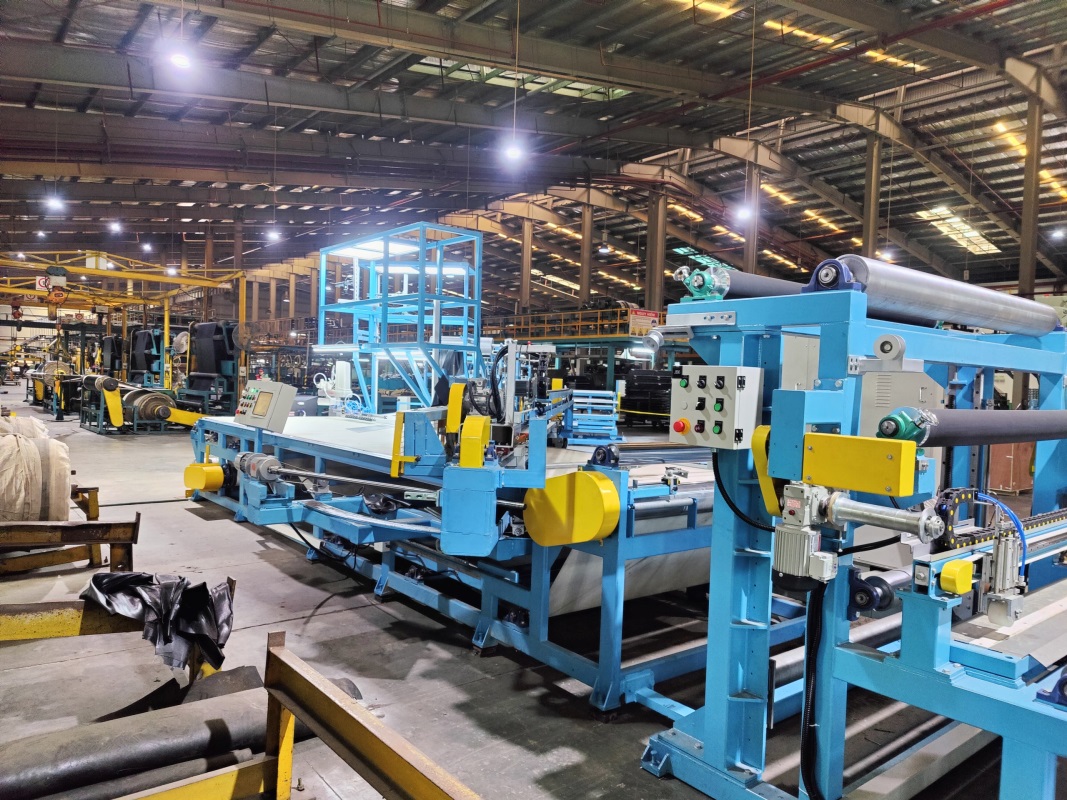
Bias cutting line designed and manufactured by the National Research Institute of Mechanical Engineering.
Notably, with determination and creativity, scientists at the National Research Institute of Mechanical Engineering have mastered the design, fabrication, installation, and successful operation of a horizontal Bias cutting line at Da Nang Rubber Joint Stock Company, helping to replace obsolete equipment, thereby improving productivity and saving production operation labor. The horizontal Bias cutting line designed by the National Research Institute of Mechanical Engineering has the following main parameters: cutting capacity of 18-22 pieces/minute; cut piece width of 80-1,100 mm; cutting angle of 45–90°; width cutting control; integration of an angle rotation mechanism and equipment support, allowing cutting of various rubber fabrics with different cutting angles on the same line system, which was previously unachievable. In particular, the fabric cutting width is expanded due to the ability to actively change the conveyors. Additionally, the research team integrated a robot into the cutting line, thereby reducing operating labor while improving the quality of cut fabric with higher precision than existing solutions.

Equipment diagram of the horizontal Bias cutting line researched and manufactured by the National Research Institute of Mechanical Engineering.
The success of the research, design, and fabrication of the synchronized horizontal Bias fabric cutting line has reduced equipment investment costs by 20-30%, while also reducing conventional labor costs for the fabric cutting stage serving the automobile tire industry by approximately 50%. Currently, the National Research Institute of Mechanical Engineering can supply and install synchronized horizontal Bias fabric cutting lines for domestic and foreign tire manufacturing companies upon demand.
Source: Vietnam Journal of Science and Technology
Related News
- Discuss solutions to promote foundational industries in the new period
- Research results on the application of robots in a detergent powder manufacturing plant
- Specific mechanisms and policies are needed to develop mechanical engineering products with large market capacity in the period 2026-2045.
- Mastering Heat Exchange Equipment: A New Step Forward for Vietnam's Mechanical Engineering Industry


